Trekking poles: choosing and using them
What poles really do for your knees, which kind to buy, and how to set the length and use the straps.
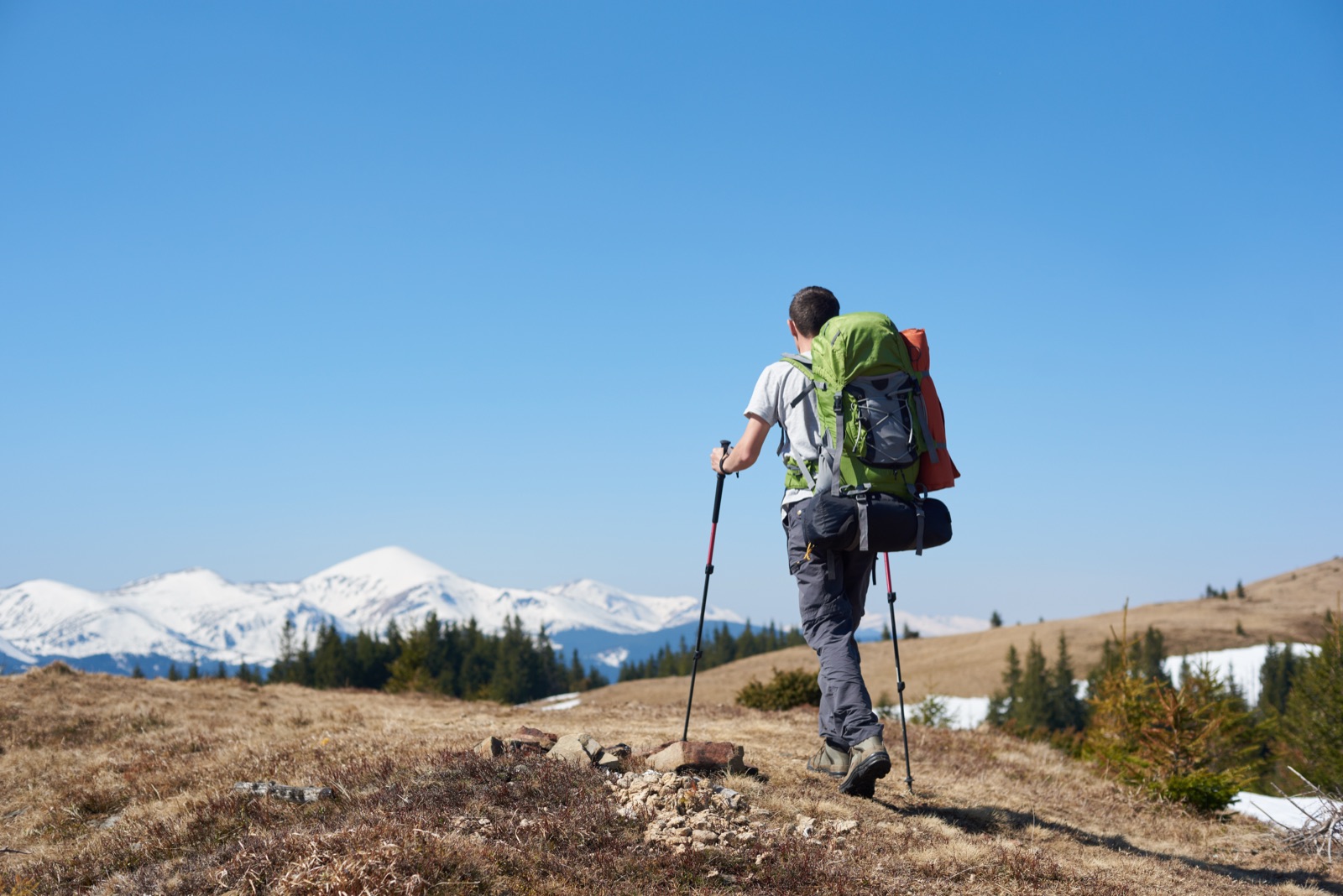
Poles turn two legs into four. They are most useful going downhill with a pack, on loose or wet ground and when crossing streams, and many people find them helpful on long climbs too.
What they do for your knees
In a laboratory study of downhill walking, using poles lowered the forces on the knee by roughly 12 to 25 per cent, partly because some of the load goes through the poles and partly because walkers lean slightly forward. A 2020 review of the research came to the same overall picture: less load on the legs and better balance, especially with a heavy pack, but a slightly higher heart rate because the arms are working too.
Kinds of pole
- check_circleTelescopic: two or three sections that slide into each other. Easy to adjust for every slope.
- check_circleFolding: sections joined by a cord that fold into a short bundle. Light and easy to stow, usually with less length adjustment.
- check_circleLever locks are quick to use with gloves on and easy to check at a glance; twist locks can slip if they are not tightened well.
Aluminium or carbon
- check_circleAluminium is a little heavier but tends to bend rather than break, and a bent pole can often still get you home.
- check_circleCarbon is lighter and absorbs vibration, but it can snap under a sudden sideways load, for example when a pole gets stuck between rocks.
Setting the length
- check_circleOn flat ground: with the tip next to your foot, your elbow should bend at about a right angle.
- check_circleUphill: shorten both poles a little, by about 5 to 10 centimetres, so you are not lifting your arms too high.
- check_circleDownhill: lengthen them a little so you can plant them ahead of you without bending forward.
- check_circleAcross a slope: make the uphill pole shorter than the downhill one.
Using the straps
Put your hand up through the strap from below, then hold the grip with the strap running under your palm. This way you can push down on the strap instead of squeezing the grip all day.
Take your hands out of the straps when crossing a river, on steep ground where you might fall and when you need your hands for scrambling. You must be able to let go of a pole that gets caught.
Tips and baskets
The hard metal tips grip on rock and earth. Rubber caps protect the tips and reduce noise and scratches on hard surfaces and pavements. Small baskets stop poles sinking in mud; wider snow baskets are used in winter.
On paths with lots of visitors, keep the tips on the path and away from the edges, where they speed up erosion.

Add your poles to My Gear in Pathsie so they make it into every trip checklist.
verifiedSources
This guide is based on the advice of these organisations.
- Schwameder et al. (1999) — Knee joint forces during downhill walking with hiking poles, J Sports Sciopen_in_new
- Are trekking poles helping or hindering your hiking experience? A review (2020)open_in_new
- MEC — How to choose trekking polesopen_in_new
- Transa — Hiking polesopen_in_new
- REI Expert Advice — How to use trekking polesopen_in_new
This guide is general information, not a substitute for training. Learn these skills on a course or with an experienced guide before relying on them.